1812 – 2026
The Russian campaign, after Minard: a homage in motion
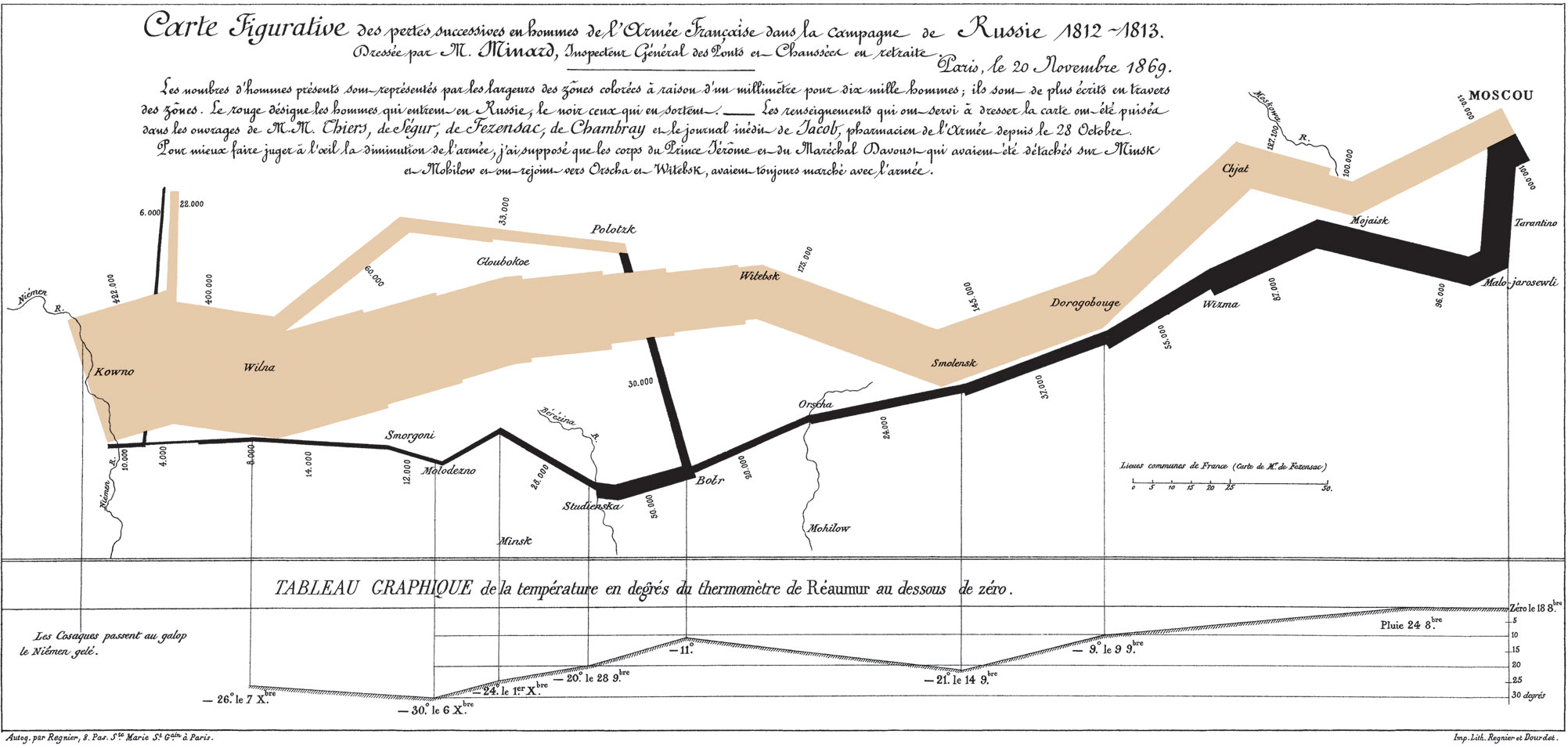
In 1869, Charles Joseph Minard drew what became of Napoleon's army in Russia. Here, his map comes to life: this is, word for word, what the animation tells.
Four parts
- The map explained
Nine points, each on a detail of the original: what Minard drew, and how to read it. - The chronology
Twenty-four steps, from the crossing of the Niemen to the return: each with the animated map that day, a painting of the time, and its sources. - The context
Europe in 1812, the tsar, the cost of the campaign: what the map does not say. - Making-of: how this animation came to be
Ten days, one person and an AI: the exchanges, as they happened.
The author's note
May past wars remind us, in troubled times, that war is never inevitable, and that our history binds us more than it divides us. We owe it to those who marched, and to those who will.
Pascal Thomet, October 2026
Where the data comes from
Everything the animation shows is fetched live, from where it lives:
- Minard's figures, as Michael Friendly digitized them for his Re-Visions of Minard: three tables (the army's path and strength, the cities, the temperatures of the retreat), from the Rdatasets collection (the R package HistData).
- Minard's original map and the paintings, from Wikimedia Commons: public domain, each credited at its step, with a link to its page.
- The rivers, from Natural Earth (public domain), simplified, and bent with the map.
- The fonts, from Google Fonts (SIL Open Font License): Old Standard TT for the text, IM Fell for the map's lettering, Bodoni Moda and Space Grotesk for the two years of the title.
The states of the downloads, and a way to fetch them again: Data and downloads, under the gear.